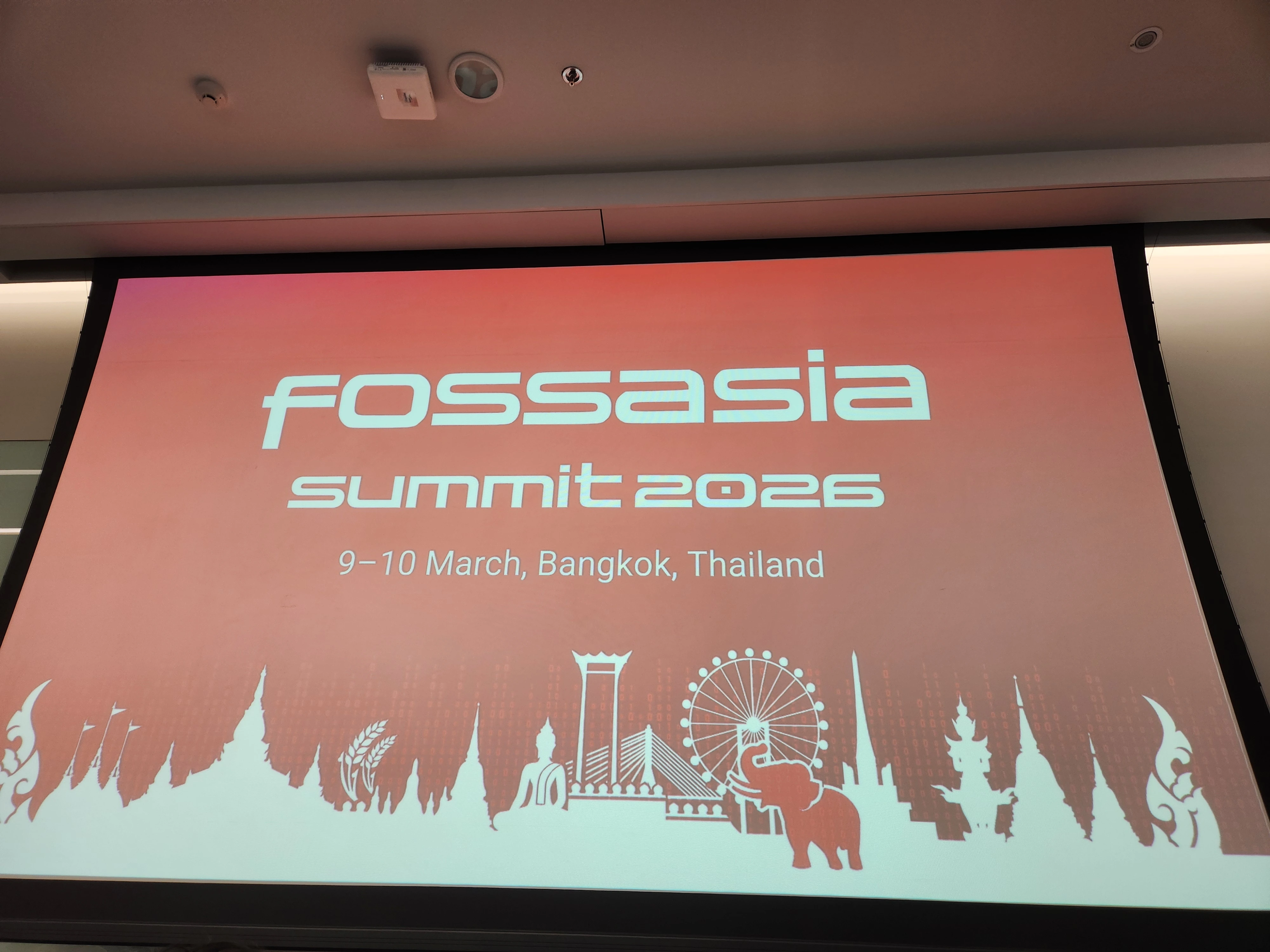
These are the interesting things I found at/got from FOSSASIA Summit 2026.
Day 1 (Mar 8)
Today is what they call “Community Day”, which was full of talk sessions but no booths.
Beyond the Blinky LEDs: Teaching How to Think Like an Engineer
This sessions talks about the DIY electronics community making fancy gadgets, such as making a humidity/temperature sensor from ESP32 and putting together a Grafana dashboard. However, there is one big problem with guides found on the internet: they make us follow step by step, without thinking or asking why this needs to be done.
They also assume you already know about things, which newcomers reading the guide usually don’t. When a step fails, the reader would get stuck and might as well abandon the whole thing, rendering the guide useless.
How to Foster Students as Open Source Software Developers
The professor talked about the problem with current programming classes: student write code, submit to teacher, and the teacher grades it. This way, there is no collaboration.
An alternative to this is to make learning, especially science and research, become a shared activity.
Students usually build web applications for data collection, visualization, or interactive experiences. This is a good chance to make them publish source code to public repositories, on real hosting platforms with open licenses.
This encourage peer collaboration and verification, reduce black box science and align with open science movements.
This will also introduce collaborative mindset, help understand the concepts of intellectual property and make students become better developers down the line.
Recommend Open Source apps to a new user
The speaker talked about the journey of a new Linux user trying out their first distro and looking for applications and software for daily usage.
There will be issues for sure. However these days many users can copy/paste the error message into an LLM and it will give out solutions, even though it’s not perfect.
At the end of the short talk, the speaker brought up a list of productivity-related applications on the Linux desktop. Participants contributed bu adding more software to the list, such as Inkscape, LibreOffice, Krita, Bazaar, etc.
Running Snowflakes to help censored people
The Tor Project co-founder introduced the concept of “pluggable transport”, used by Snowflake.
Snowflake makes traffic look like WebRTC, which censored people can leverage to get around censorship. It’s pretty safe to be a Snowflake proxy, since people will get random Snowflake proxy when they use it.
You can run a Snowflake proxy in multiple ways, a desktop browser extension, a standalone server, or even on mobile phones via Orbot app’s Kindness feature.
Testing Is Everyone’s Job (and Why That’s Hard)
Testing is not just for QA. It’s a shared responsibility. Instead of just blaming the QA for any “defect”, let’s ask “What could break because of this change?”
This mindset shift makes everyone involved in the process try to find the root cause of the issue together.
Open source projects usually handle this very well. If you look at many public open source projects, we’ll see that there is something called issue templates. This will ask the reporter questions like:
- What’s the problem you are facing
- Expected results
- How to reproduce
- System information
The most important part in here is “How to reproduce”. Since it’s near-impossible for QA teams to list out all test cases/scenarios from the real world. This will help whoever’s involved make a better product eventually.
Balancing Community Impact and Motherhood: A Journey in Women in Tech
This talk was about someone that needed to balance what you can cope with, what pays you and what you enjoy, while managing daily stress, workplace stress and personal expectations at the same time. They balanced things out by the following ways:
- Family is not everything
- Some me time
- Be all you can be There’s also Agile process at home, by using tools like Miro to create a board with family goals, retrospectives and yearly plans.
Apache Airflow 101 (with Cloud Composer) | Beginner-Friendly Introduction
Apache Airflow is a workflow orchestration tool which is very powerful, since we can write Python code for it to define complex workflows such as ETL jobs.
The UI visualizes the workflow, called DAG, which also make failures easy to spot.
Scrum Helper: A Simple Way for Coordinating Open Source Development
Scrum helper is a Google Chrome extension that hooks up to your GitHub/GitLab account, collect your activity data and present them in a scrum-friendly format
Day 2 (Mar 9)
As I arrived at the event, I saw many booths already exhibiting things. I checked out DeepComputing, Ubuntu, Matrix among few others in the morning.
I also met folks developing Aurora Store and maintaining LineageOS, which we had quite good talks since I’m a Wonderful Mobile contributor and told them about our ambitions to make custom ROMs in the future.
During the group photo activity, I met my friends that we have contacts on the Fediverse, and that reminded me to do a security update for my Sharkey instance
I also visited the other side of the event, I met the KDE, GNOME/Fedora, Debian and a few other booths. It was really fun when I talked about how I use my Linux setups in a professional setting. They looked really delighted when I told them Fedora Linux and KDE software are gaining popularity, and it’s even better that I also happened to be a Friend of GNOME, which made organizing booths like this possible.
Linux on ARM laptops: The Future Today
This talk presents the current state about Linux on ARM laptops, particularly Qualcomm Snapdragon devices, with other SoC vendors like MediaTek and NVIDIA coming to market in the future.
They also mentioned challenges to the currently most popular Linux on ARM laptop setup that is Asahi Linux on Apple Silicon MacBooks, such as the different page size.
Don’t Trash It, Hack It: Reverse engineering secrets & repurposing ISP Routers
The speaker presented opening up an ISP router, connecting to its serial console, dumping things and seeing many insecure practices such as hard coded backdoor credentials in the file system. This lets the user gain root access and can modify the router to do things like becoming a network-wide adblocker.
Day 3 (Mar 10)
I was mainly at the KDE booth in the morning, there were student visitors coming to the KDE booth and they were impressed by what KDE software can do for them as computer engineering students. I showed what KDE has to offer, from Plasma, Konsole, KDE Connect to the Flatpak ecosystem around it. It was an eye opener for them.
Vibe Coding: Practical AI Workflows for Developers
This workshop demonstrated setting up our own Cursor/ClaudeCode-like vibe coding environment, using Ollama and OpenCode. The demonstrator used the setup to test doing various things like explaining the code architecture from the Eventyay’s code repository.
How We get On Call Wrong (and What to Do About It)
IT Incident Response usually fall under 3 types: Work day, late night and weekend.
On work days, everyone in the team is available. Full capacity.
On late night call, the team members responsible woke up, has limited capabilities and become failure prone. This can lead to many failures down the line because failing to follow whatever’s in the documentation, which usually assume full capabilities/capacity.
When subsequent failures occur, it can completely ruin one’s sleep cycle, which is very unhealthy for the workers. Lesson here is to consider the 3AM limited capability when writing documentation, aka make the most n00b people able to understand and operate the system with multiple failsafe mechanisms.
On weekends, the teams members are fully awake, but might be outside running errands. This means limited resources to access, such as not having the company laptop on standby. Lesson here is to make critical response operations available here, such as doing so on mobile phones.
Lazy-L10N: Accelerating Open Source Translation with Local LLMs and pgvector
This talk tells stories about KDE localization projects, where SVN is still used and changes are automated by Scripty, which means real translator contributions are hidden and ‘blame’ becomes irrelevant.
The speaker used a shell script to checkout KDE l10n fron SVN, extract logs excluding Scripty, and build a searchable history database using PostgreSQL, which can be used by OpenCode to assist in translations with historical contexts.
The Fedora Badges Revamp Project Story - Modernizing Legacy Running Infrastructure
This session tells the history of the Fedora Project’s Badges system, from what it does, its origins, what it went through until the stack refresh in 2025-2026 with modern features like dark mode, PWA and MCP incoming.